

Custom Sizes. Greater Possibilities.
The flexibility to match your requirements. The responsiveness to keep production moving.
A titanium fitting machined from block, a set of components nested on plate, and a shaft turned from bar all start with the same question: how much material does the job actually need?
That decision determines how much stock the shop must handle, how much metal it must remove, and how long the job spends on the machine. When the starting dimensions match the part and the process, the savings can carry through every production run.
Across Sierra Alloys, Sierra Sheet & Plate, and TSI Titanium, STS Metals helps customers specify starting dimensions that fit their parts, equipment, and production schedules.
Built Around Your Part
Custom forged block | Sierra Alloys
For thick fittings and other components machined from solid stock, a standard block can leave excess material on several faces. Sierra Alloys uses open-die forging to produce blocks sized around the part envelope. The process uses flat or simply shaped dies, so custom dimensions can be produced without dedicated tooling shaped to the part. That gives customers a practical option for short runs and recurring production alike.
Custom plate | Sierra Sheet & Plate
Sierra Sheet & Plate can tailor thickness, width, and length. Ordering closer to the required thickness can reduce how much stock the shop needs to mill from the faces. Custom width and length can improve how blanks nest on the plate, reduce edge trim, and help the shop get more usable blanks from the material it buys.
Precision custom diameter bar | TSI Titanium
On a turned component, excess diameter can mean extra passes along the length of the part. TSI Titanium supplies bar in precision custom diameters so customers can start closer to the size the job calls for, with the allowance needed for turning and finishing. On repeat work, the time saved turning each piece adds up across the run.
Less Material to Remove. More Capacity to Produce.
When machining centers are booked and capital budgets are tight, start by looking at how much time each part spends on the spindle. A forged block sized closer to the finished part can cut roughing time and free up hours on the equipment already on the floor. Fewer passes can also reduce insert wear and leave less scrap to handle.
The bigger opportunity is capital expenditure (CAPEX) avoidance. Before committing to another machining center, multiply the cycle time saved per part by the number of parts you run. If the hours you recover on your bottleneck machines cover the additional workload, you can take on that work with the equipment you already own and defer or avoid the purchase.
The example below shows how those recovered hours add up across a production run, alongside the savings in material and cutting tools.
Close to the Part. Ready for the Process.
Back-of-the-napkin savings formula
Estimated savings per part = material savings + machining savings + tooling savings + net scrap savings
In aerospace, the buy-to-fly ratio compares the weight of material purchased with the weight of the finished part. A 10:1 buy-to-fly ratio is a common benchmark for machined aerospace components. At that ratio, the shop buys ten pounds of material for every pound that remains in the finished part. Actual ratios vary with part geometry and the starting stock.
Consider a 15 lb finished titanium part. Using the 10:1 benchmark, the shop starts with 150 lb of titanium. If custom sizing brings the ratio down to 9:1, the shop starts with 135 lb for the same finished part. That’s 15 lb less titanium purchased per part, before factoring in machining and tooling savings.
| Source of savings | Illustrative calculation | Savings per part |
|---|---|---|
| Material purchased | 15 lb less at $28/lb, assuming the same price per pound | $420 |
| Machining | 12 minutes saved at $125/hour | $25 |
| Cutting tools | Estimated at 20% of machining savings | $5 |
| Estimated savings before scrap adjustments | $450 |
Example calculation before scrap adjustments: (150 lb − 135 lb) × $28/lb + (12 min ÷ 60 min/hr) × $125/hr + ($25 × 20%) = $450 per part
At 500 parts, that’s $225,000 in estimated savings, 100 spindle hours freed up, and 7,500 fewer pounds of chips and other scrap to handle. The dollar estimate excludes changes in scrap handling costs and resale credit and assumes cutting tools are tracked separately from the machine rate.
Savings estimator
Put your own numbers in.
Back-of-the-napkin, not a quote. Capacity is the machine time you free up on equipment you already own, the difference between running more parts and ordering another machining center. Scrap handling and resale credit are not included.
The right starting size still leaves room for the work. A forged block needs stock for workholding, surface cleanup, and forging tolerances. A plate layout needs room for cutting and edge allowances. A bar needs enough stock to clean up and hold the finished diameter. Sharing those requirements early lets us size the material around how the part will actually be made.
Forged block, titanium
How close you can get
A near net block starts closer to the finished part than a standard size does. It does not start at the part. Four things keep stock on it.
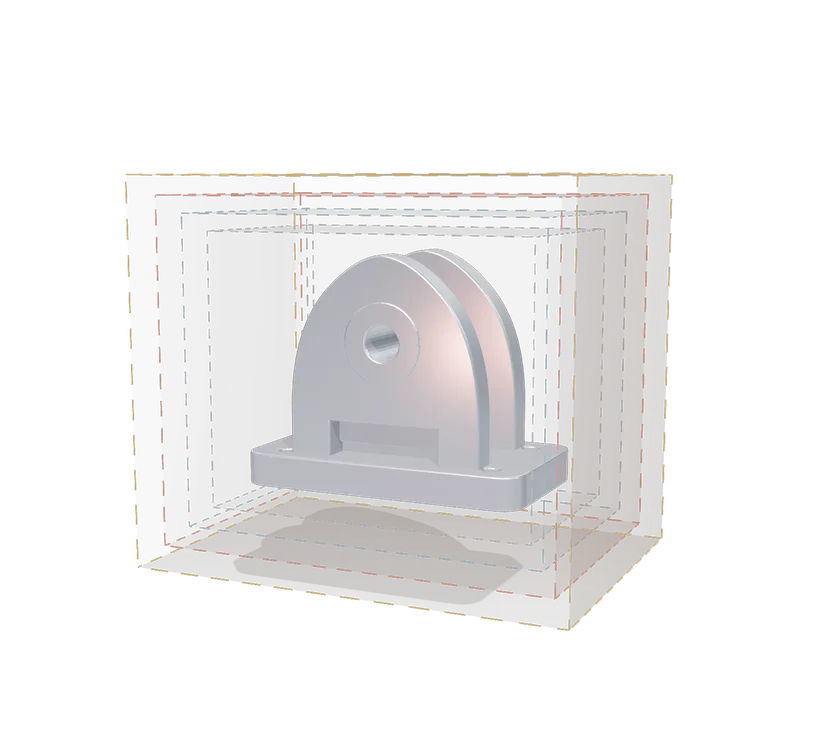
Interactive view needs WebGL, which this browser or page is not allowing.
Showing a still of the finished block instead.
-
The finished part
What the drawing calls for. Everything outside this surface is stock that has to come off on a machine.
-
Workholding
The part has to be clamped while it is cut, and material gets left on for that.
-
Cleanup
A forged surface is not a finished surface. Stock stays on for conditioning and for the finish the drawing calls for.
-
Alpha case
Titanium forged in air develops an oxygen-enriched surface layer. It is removed by machining, and the allowance for it is not optional.
-
Tolerance on the forging
Open-die work holds a looser envelope than a closed-die part does, so the block is quoted with that tolerance included.
-
As forged, then machined
A near net block still carries machining stock. It carries less of it than a standard size would. Watch the four layers come back off.
Each step is named on the drawing as it happens, so you can watch or read. Click any step to stop on it, and Play picks up from there. Section cuts the allowance layers away on the near side.
Responsiveness Is Part of the Product
A custom size has to fit the schedule as well as the part. A short run may need a quick answer on what can be produced. A recurring program needs consistent dimensions and dependable supply across releases.
STS Metals pairs custom manufacturing with industry-leading lead times to support both. When the dimensions, quantity, and required delivery date are part of the same conversation, our teams can evaluate the material and the schedule together, from the first lot through repeat production.
Start With the Part. Build Around the Schedule.
Send us your alloy, specification, part or blank dimensions, quantity, and required delivery date. If you have a plate nesting layout, a machining allowance, or a target bar diameter, share it with us. Those details help us see where custom sizing can make a difference.
Whether the job calls for a forged block from Sierra Alloys, plate in a custom thickness, width, and length from Sierra Sheet & Plate, or precision custom diameter bar from TSI Titanium, we will work with you to find the right starting material and keep production moving.
Visit stsmetals.com to connect with our team.
Built on trust, delivered with integrity.
Our Other Articles
STS Metals Acquires Forged Products Assets and Retains Its Experienced Workforce
STS Metals is proud to welcome STS Forged Products to the STS Metals family, adding a 6,500-ton open-die forging press that significantly expands the scale and range of forging capabilities available to our customers.
Read More
Getting the Starting Size Right
Buy twenty pounds, fly one. On aerospace structural work, the ratio of what gets bought to what ends up flying commonly runs near ten to one, and on complicated parts it reaches twenty to one.
Read More
Why the Wire Surface Matters
Have you ever counted how many companies touch a fastener before it exists? One continuous surface runs through all of it, and the coating on that surface decides more than a purchase order line suggests.
Read More